How do digital tools shape music consumption?
Introduction
I have always had an appreciation for music as I have been surrounded by it growing up. No my parents aren’t musicians but they were always playing music around the house. The first memory I have of owning something to listen to music on is my iPod. I also had a portable boombox that allowed me to play CDs as well as tune into the radio. Eventually I got my own phone and that is how I mainly listen to music. I will be walking you through the history of music consumption and how it compares to my own journey. I will also be talking about the current role of digital tools and what the future of music consumption may look like.
History of Music/Music Consumption
Before we dive into the current roles of digital tools in the music realm I want to discuss the history of how people have been able to consume music. I also will go into depth about my personal journey with music consumption.
1800-1940: Thomas Edison invented the phonograph in 1877. This was one of the more known and popular tools that allowed people to record and play back any audio or sound. Through this invention we were able to evolve the phonograph to a record player. The record player allowed vinyl records to play different songs with the use of a hand crank to go through each song. Nowadays record players change through songs on their own and each vinyl record can hold a lot more songs from when they were first invented. I was given my first record player a few years ago and it’s from the brand Victrola. If you know anything about turntables/record players you would know that any suitcase design is not ideal and will most likely ruin your vinyls. That is something I could explain deeper sometime in the future.
1940-1980: In the 1960s-1980s we are introduced to the 8-track which allowed for non stop listening unlike having to flip and re-flip vinyls. It was also a lot more portable then the record player. However in 1963 cassette tapes start to gain popularity especially as their sound quality was a big improvement from the 8-track. I have never personally come across 8-tracks or cassette tapes but I do remember my mom used to have a walkman.
1980-2000: We start to see the rise of compact discs or CDs as they are normally referred to. The CD had a lot more space for data and was one of the more prominent ways of being able to record and listen to digital audio. I remember growing up and seeing the collection of CDs my mom and dad both had. They both had their own distinct music taste and there own way of keeping the CDs. My dad kept all of his CDs in something similar to foldable travel case. My mom kept all her CDs in their original packaging and usually stored them in her car. I remember I was given a pink boombox that allowed me to listen to radio stations and any CD that I owned. I used my boombox quite a lot even after I got my own phone.
2000-Present Day: I remember getting an iPod during the late 2000s or early 2010s. My dad and i bonded over this as he would frequently download songs on his computer to create his own playlists. This gave him the freedom to listen to what he actually enjoyed. He often helped me download songs from the internet so that I could be able to listen to music on my iPod. I really enjoyed the sense of independence I had by being able to take my iPod anywhere and being able to stream the music I liked. Currently we are all surrounded by streaming services, there are so many to choose from. Many services offer a free version and a paid membership for a more enjoyable experience. Memberships usually give you the options of unlimited skips, endless playlist curation, offline listening and an ad-free listening experience. I mainly use Spotify since it is the one I grew up with and I like to stick with what I know.
Information above can be found in more detail, here.
(key highlights and fun fact)
Current role of digital tools
We mainly see digital tools play a huge role via streaming services. Many people have subscriptions to apps like Spotify, Apple Music, Youtube Music etc. I think it is important to note that the money from these subscriptions isn’t going to musicians. The rise of digital tools has lead to the downfall of physical media such as CDs and vinyls which notoriously paid musicians a lot more than streaming services.
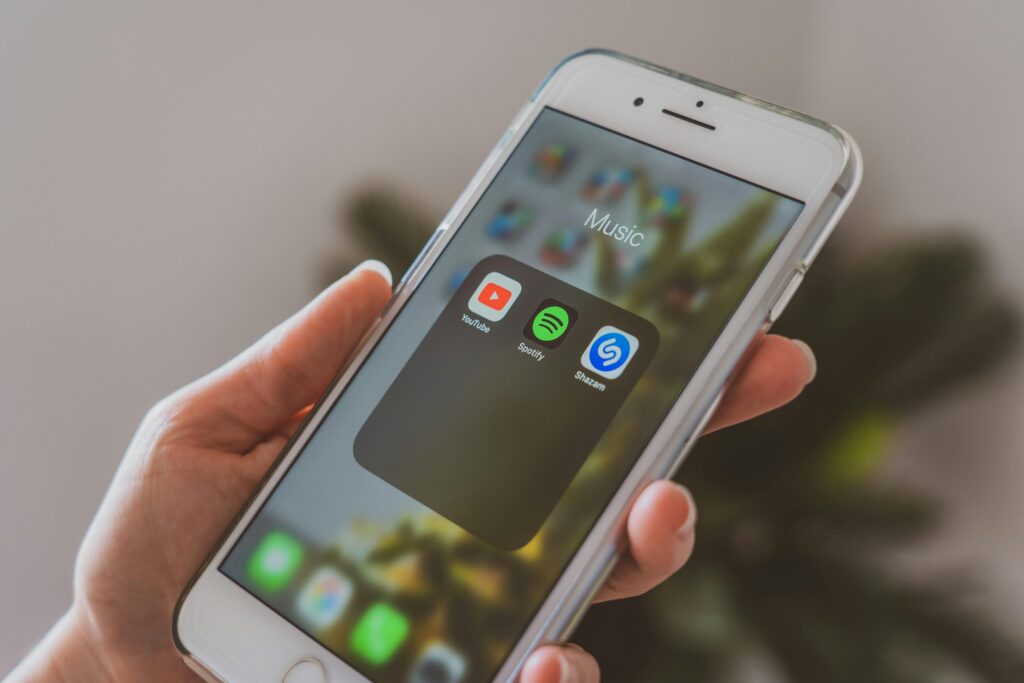
Photo by Castorly Stock from Pexels
Future Implications
This next section is a few questions and thoughts that I have about what the future of music/music consumption will look like.
- Will current streaming services figure out a way to pay artists fairly?
- We have seen AI become a lot more normalized, even with all of the negative effects it has, from using it to solve math problems or to help with recipes, will we see an AI streaming service that allows people to listen to music?
It is pretty common knowledge that Spotify doesn’t pay their artists fairly which may be a reason why so many artists have different merchandise. Theres limited edition CDs, vinyls and clothing, signed merchandise and collectible items. This is where majority of artists fundings come from which is why these items may seem repetitive to fans. I wonder if we were to see apps like Spotify fix artists revenue, will this cause a pause in merchandise constantly being pushed out?
We have also seen many evolutions when it comes to the music industry and how people stream music. Have we reached the final stages or will this industry continue to evolve?
Conclusion
I really enjoyed this project and getting to put a webpage together. I found this an interesting way to explore my research question and make it more engaging then having one simple answer. Prior to this project I wasn’t aware of the first piece of technology that made listening to music possible. I feel like I can walk away from this assignment having a better understanding of music and how we have consumed it has changed or remained the same. Digital tools are constantly shaping the world around us. It was overwhelming to focus on one area but being able to do research on something that I truly am interested in was refreshing. As someone who wants to work with musicians I think it is important to know how people are streaming music and how that may change.